

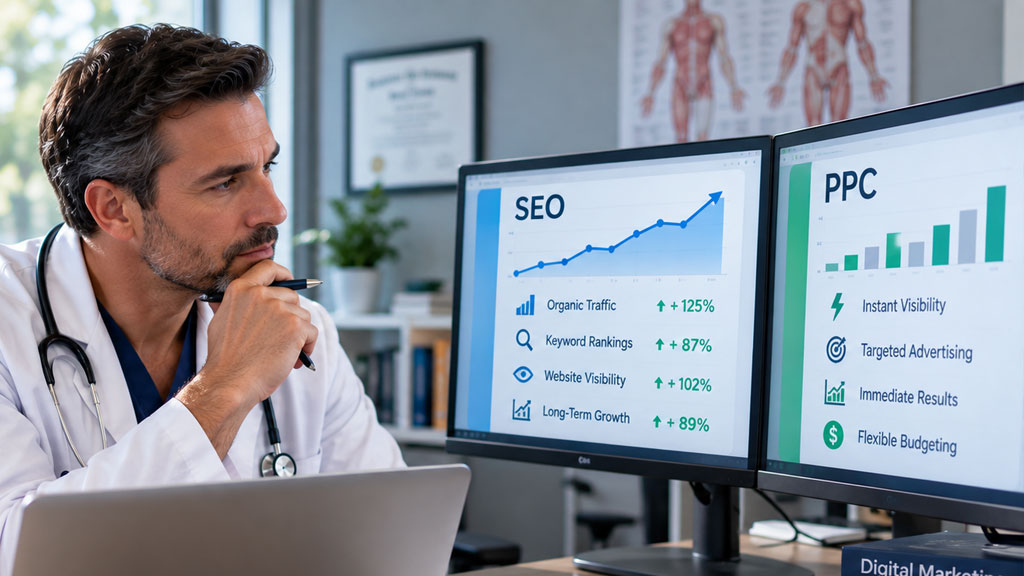
Healthcare SEO builds organic visibility over time, while healthcare PPC pays for immediate search visibility. SEO often fits long-term patient growth, while PPC fits faster, targeted demand. Many medical practices use both. The right mix depends on budget, timeline, competition, appointment capacity, website performance, and the cost to gain a new patient.
Healthcare SEO vs PPC at a Glance
| Factor | Healthcare SEO | Healthcare PPC |
|---|---|---|
| Visibility | Organic search | Paid search |
| Speed | Builds over time | Can start quickly |
| Cost model | SEO investment | Ad spend plus management |
| Pay per click | No | Usually yes |
| Targeting control | Less direct | High |
| Testing | Slower | Faster |
| Best fit | Long-term visibility | Fast, targeted demand |
The key difference is simple. SEO builds search assets. PPC buys search visibility. However, neither channel should be judged by clicks alone. The real goal is to gain the right patients at a cost the practice can support.
What Is Healthcare SEO?
Healthcare SEO, or search engine optimization, helps a medical practice appear in unpaid search results. It can include service pages, local SEO, Google Business Profile work, useful content, technical SEO, and website improvements.
For example, an orthopedic practice may create useful pages about knee pain, sports injuries, joint care, and each office location. These pages can help people find the practice while they research care. Strong content can also make the practice easier for search and AI systems to understand.
What Is Healthcare PPC?
Healthcare PPC uses paid ads to reach people who are searching for medical services. Google Ads is a common example. A practice can target certain searches, services, and locations. It can then send users to a page that matches what they need.
PPC gives a practice more short-term control. However, paying for a click does not mean a patient will book. The page still needs clear information, trust signals, and an easy next step.
How Fast Do Healthcare SEO and PPC Work?
PPC can provide search visibility faster, while SEO usually needs more time to grow. A paid campaign can begin reaching users after it is set up and approved. SEO works differently. Search engines need time to find, understand, and compare pages.
There is no safe promise that SEO will work within a fixed number of days or months. Results can vary based on the website, market, location, competition, and quality of the work.
Which Costs More: Healthcare SEO or PPC?
There is no single answer. SEO can require content, technical work, local SEO, website updates, and ongoing strategy. PPC requires ad spend and may also need campaign management and landing-page work.
Instead of asking which channel gets cheaper clicks, ask what it costs to gain a new patient. A $20 click may make sense if it leads to the right patients. A $5 click is not cheap if no one books.
A useful path to measure is:
Search → Website Visit → Qualified Inquiry → Appointment → Patient
This helps a practice focus on business results instead of traffic alone.
When Does Healthcare SEO Make Sense?
SEO may be a good fit when long-term search visibility is a main goal. It can also help practices that have many services, locations, or patient questions to cover.
- You want long-term organic visibility.
- Patients often research before they book.
- Your practice has weak organic rankings.
- You want to grow local search visibility.
- You have several services or locations.
- You want less dependence on paid traffic over time.
However, SEO may not solve an urgent need for patients by itself. It is a long-term growth asset, not an emergency switch.
When Does Healthcare PPC Make Sense?
PPC may fit when a practice needs faster and more targeted visibility. For example, a new provider may have many open appointments. Paid search can help reach people who are already looking for that type of care.
- You opened a new practice or location.
- A provider has open capacity.
- You launched a new service.
- You want to test demand.
- You need tight geographic targeting.
- You want faster data about search behavior.
However, do not use PPC to hide a weak website or intake process. More traffic will not fix confusing pages, missed calls, or a hard booking process.
Should Medical Practices Use SEO and PPC Together?
SEO and PPC can work well together because they solve different problems. PPC can help capture demand now. Meanwhile, SEO can build organic visibility for the future.
PPC can also provide useful data. Search terms, locations, services, and messages that produce qualified leads may point to new SEO opportunities. SEO can then turn useful ideas into service pages, location pages, and helpful content.
The goal is not to spend more on both channels. Instead, give each channel a clear job and measure whether it helps gain the right patients.
What About Multi-Location Practices?
Multi-location groups should not make one SEO-versus-PPC choice for every office. One location may rank well but need more patients for a new service. Another office may have weak local visibility across most services.
Review each location, provider, and service line. Also check appointment capacity. If a provider is already full, buying more demand may not make sense. Marketing dollars may have more value at another location or for another service.
What Are Common SEO vs PPC Mistakes?
One common mistake is measuring clicks instead of patients. Another is sending more traffic to a website that does not convert. Practices may also stop PPC as soon as SEO improves or use the same plan for every location.
Healthcare organizations should also review ads, analytics, forms, call tracking, CRM tools, and website tracking for privacy rules and platform policies that apply to them. When needed, involve qualified privacy, compliance, or legal professionals.
How Do You Choose Between Healthcare SEO and PPC?
| Situation | Strategy to Consider |
|---|---|
| Need faster visibility | PPC |
| Want long-term organic growth | SEO |
| Launching a new service | PPC plus SEO |
| Paid traffic is a major dependency | Build SEO while improving PPC |
| Testing a new market | PPC can provide faster data |
| Growing several locations | SEO plus location-based PPC where needed |
| Website converts poorly | Fix conversion problems first |
Before spending more, ask five questions: How soon do we need patients? Do we have room for them? What is a new patient worth? Does our website turn visitors into appointments? Can we measure results in a responsible way?
These answers often matter more than choosing SEO or PPC based on a general rule.
Is Healthcare SEO or PPC Worth It?
Healthcare SEO or PPC can be worth the investment when it brings qualified patients at a cost the practice can support. Do not judge success only by rankings, clicks, or leads. When possible, track qualified inquiries, appointments, new patients, and the cost to gain each patient.
Results also vary by specialty, location, competition, website quality, demand, capacity, and execution. Therefore, practices should use their own data instead of relying only on broad industry averages.
Build a Patient Acquisition Strategy, Not Just a Traffic Strategy
SEO and PPC are only part of the patient journey. A complete path looks like this: search visibility → website visit → trust → inquiry → appointment → patient.
BlueStage Marketing looks at SEO, PPC, website conversion, local search, content, AI search, and measurement as connected parts of that journey. The goal is not simply to get more traffic. It is to find where growth is being lost and improve the parts that matter.
Not sure whether your next marketing dollar should go to SEO, PPC, or website conversion? Request a healthcare digital marketing consultation with BlueStage Marketing to review your search visibility, patient journey, and growth priorities.
Frequently Asked Questions About Healthcare SEO vs PPC
Is SEO or PPC better for healthcare?
Neither is better for every practice. SEO builds organic visibility over time. PPC buys faster, targeted visibility. The right choice depends on your goals, budget, competition, capacity, and website.
How long does healthcare SEO take to work?
There is no fixed timeline. Results depend on your website, competition, location, content, technical SEO, and current search visibility. Some markets are harder than others.
Is Google Ads worth it for medical practices?
It can be. The key is whether ads produce qualified patients at a cost the practice can support. Clicks alone do not show if a campaign is working.
Can healthcare SEO and PPC work together?
Yes. PPC can provide faster visibility and testing. SEO can build long-term organic visibility. PPC data may also help find useful topics, services, locations, and search terms for SEO.
Should a new medical practice start with SEO or PPC?
A new practice may use PPC for faster visibility while building SEO for long-term growth. However, the best mix depends on budget, open appointment capacity, competition, website quality, and how soon new patients are needed.