
Medical SEO in Irvine helps healthcare practices show up when local patients search Google for doctors, treatments, and medical services. It combines local SEO, Google Business Profile work, useful medical content, technical SEO, and website improvements. The goal is simple: help the right patients find your practice and take the next step.
What Is Medical SEO in Irvine?
Medical SEO is search engine optimization made for healthcare practices. It helps patients find doctors, clinics, treatments, services, and locations through organic and local search.
A person searching “knee pain causes” may still be doing research. Someone searching for an orthopedic doctor in Irvine may be ready to choose a provider. Good SEO helps each person reach a page that fits the search.
That is why medical SEO is about more than keywords. It connects patient needs with clear, useful pages.
How Medical SEO Turns Search Visibility Into Patient Growth
Rankings are useful, but they are not the final goal. A practice needs the right people to find the right page and know what to do next.
| SEO Area | Main Goal | Possible Outcome |
|---|---|---|
| Local SEO | Improve nearby visibility | More local discovery |
| Service SEO | Rank key treatment pages | More qualified visits |
| Medical Content | Answer patient questions | More trust |
| Technical SEO | Improve site access and speed | Better user experience |
| Conversion | Make the next step clear | More calls and requests |
A useful patient journey looks like this: search → visibility → useful page → trust → inquiry → appointment opportunity.
Why Irvine Medical Practices Struggle to Rank
Poor rankings rarely come from one missing keyword. A practice may have weak service pages, poor local signals, slow pages, thin content, or a site that is hard to use.
Another common problem is chasing traffic instead of patient intent. A broad blog post may bring many visits. Yet a treatment page with fewer visits may bring people who are much closer to choosing a provider.
- Weak treatment or service pages
- Incomplete local business information
- Poor internal links
- Duplicate location content
- Slow mobile pages
- Weak doctor profiles
- Unclear calls to action
What an Effective Medical SEO Strategy Includes
A strong plan starts with patient search intent. First, find the services, doctors, treatments, and locations that matter most. Next, learn how patients search for them. Then, match each search need with a useful page.
The site should also show clear links between the practice, doctors, specialties, treatments, and locations. This helps both patients and search systems understand the site.
More content is not always better. Strong treatment, doctor, and location pages may add more value than dozens of broad blog posts.
Local SEO and Google Maps for Irvine Medical Practices
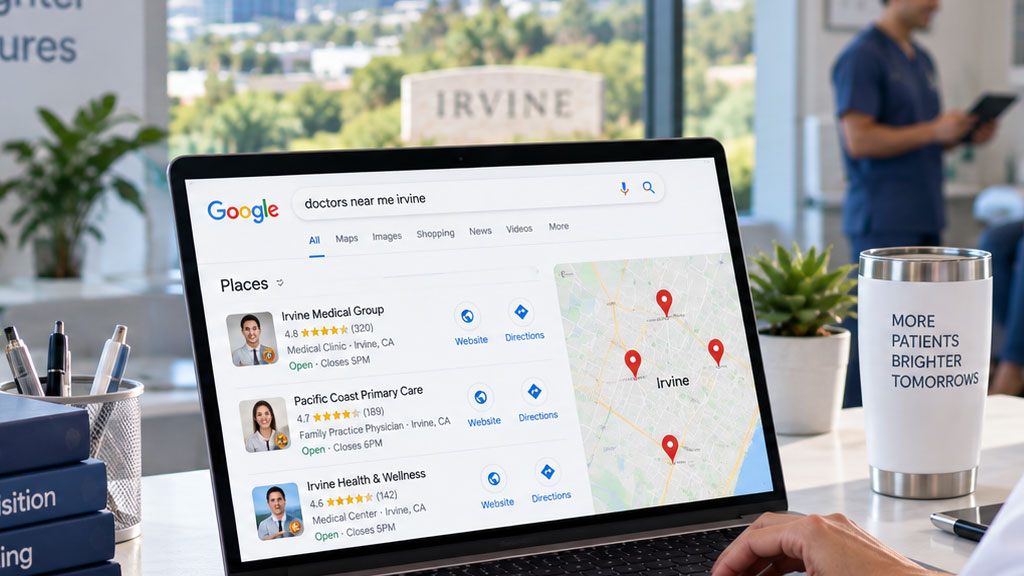
Local medical SEO helps Google connect a practice with nearby patients. Key areas include Google Business Profile, accurate contact details, services, reviews, local pages, and clear location information.
A good location page should be useful. It may include services, doctors, hours, directions, parking, phone details, and appointment options.
Avoid making many pages that only swap one city name for another. Each local page should serve a real patient need.
Medical Content and Technical SEO
Medical content should answer real patient questions in clear language. Useful pages may cover treatments, conditions, doctors, services, locations, and common questions.
Trust matters too. When it makes sense, show who wrote or reviewed the content. Add real credentials and update dates. Do not create fake expert signals just for SEO.
Technical SEO supports this content. Important work can include site structure, mobile use, page speed, internal links, redirects, indexing, sitemaps, and structured data.
SEO for Multi-Location Medical Practices
Multi-location medical SEO needs a clear page structure for each real office. Search engines and patients should be able to understand which doctors, services, and specialties are linked to each location.
Each office page should contain useful and unique details. Copying the same page and changing only the city name can create weak content.
Multi-location groups should also watch for pages that target the same search intent. Those pages may compete with each other instead of helping the site grow.
Medical SEO and AI Search
Patients can now find health information through classic search results, AI answers, and voice tools. This makes clear information even more important.
Useful pages should give direct answers, clear facts, real expert details, simple comparisons, and easy-to-follow links between doctors, services, conditions, and locations.
There is no known trick that can guarantee an AI citation. A safer plan is to create original, clear, accurate, and useful content that both people and machines can understand.
How to Measure Medical SEO Results
Medical SEO should be measured from visibility to business results. Rankings and impressions show search visibility. Clicks show traffic. Calls and forms show inquiries. Appointment requests show a deeper level of action.
A simple model is: visibility → traffic → inquiry → appointment → patient.
This matters because more traffic does not always mean more patients. A smaller amount of high-intent traffic may be worth more than thousands of broad visits.
Healthcare practices should also review how forms, analytics, call tracking, ads, and booking tools handle sensitive data. The right setup can depend on the data, tools, vendors, and rules that apply to the practice.
Medical SEO vs. Google Ads
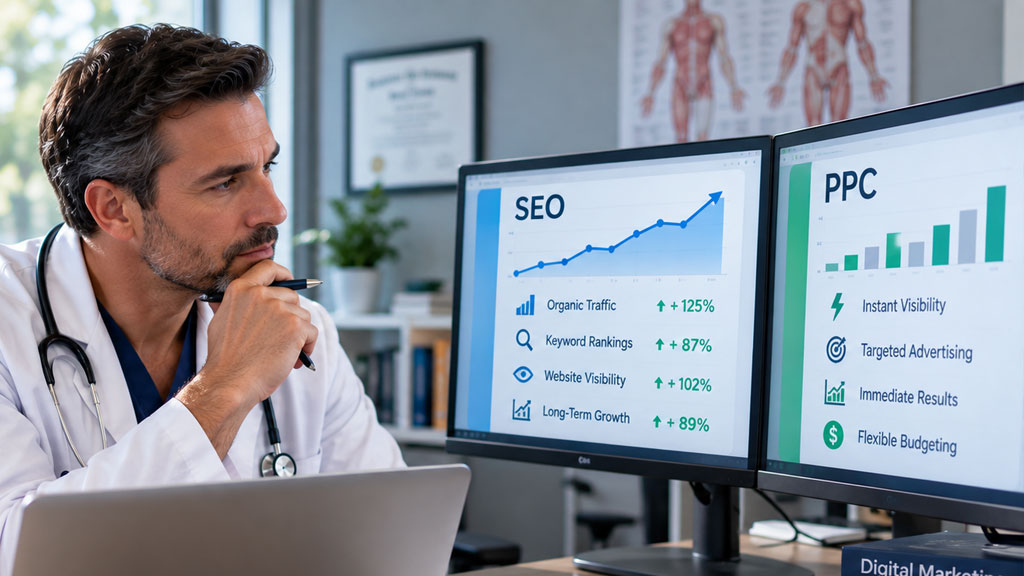
Medical SEO and Google Ads serve different roles. Paid search can create visibility fast while campaigns are funded. SEO often takes longer, but it builds organic visibility and useful website assets over time.
| Factor | Medical SEO | Google Ads |
|---|---|---|
| Placement | Organic | Paid |
| Speed | Usually slower | Usually faster |
| Per-click cost | No direct organic click fee | Paid clicks |
| Content assets | Yes | Limited |
| Ongoing work | Yes | Yes |
Many practices use both. Ads can help capture demand now while SEO builds a wider organic presence.
How Long Does Medical SEO Take?
There is no set timeline for medical SEO. Results depend on competition, site quality, current authority, specialty, location, technical issues, and content.
Some fixes may help early. Larger gains can take longer. Track useful signals such as search visibility, qualified visits, calls, forms, and appointment requests.
Be careful with any company that guarantees a specific organic ranking by a fixed date. An SEO company does not control Google’s rankings.
How Much Does Medical SEO Cost?
Medical SEO pricing depends on the amount and type of work needed. A small, single-location practice has different needs from a medical group with many doctors, services, and offices.
Cost can depend on competition, site size, content needs, technical problems, local SEO, and reporting. Compare proposals by strategy, work, skill, and measurement instead of price alone.
How to Choose a Medical SEO Company
A good provider should explain what is wrong, what it plans to change, why the work matters, and how results will be measured.
- Does it understand healthcare search?
- Can it explain its local SEO plan?
- Who creates and reviews content?
- Does it handle technical SEO?
- Can it support many locations?
- How does it measure patient inquiries?
- What work is included?
- Who owns the content and assets?
- How does it approach AI search?
- Does it make ranking guarantees?
Clear answers matter more than sales claims.
Common Medical SEO Mistakes to Avoid
Common mistakes include keyword stuffing, weak service pages, copied city pages, poor links, generic AI content, ignored Google Business Profiles, and reports that measure rankings but not inquiries.
Another mistake is doing more before fixing what is broken. A technical problem or poor conversion path may deserve attention before another 20 blog posts are published.
Is Medical SEO Right for Your Practice?
Medical SEO can be a good fit when patients search for your services, your practice has room to grow, and you can invest in useful website improvements. It may be especially useful for specialty practices and multi-location groups that want more organic visibility.
SEO may not be the first priority if your practice cannot take new patients, misses many calls, has major reputation issues, or needs new demand at once. In those cases, fixing the main business or website problem may create more value first.
Request a Medical SEO Audit
Blue Stage Marketing helps healthcare organizations connect SEO, local search, content, website experience, and measurement with patient acquisition goals.
Request a Medical SEO Audit to find search gaps, weak pages, local visibility issues, competitor opportunities, and conversion problems that may be limiting your practice.
Medical SEO Irvine FAQs
What is medical SEO?
Medical SEO helps healthcare practices improve search visibility for doctors, treatments, services, conditions, and local searches. It can include local SEO, content, technical work, site structure, and conversion improvements.
How does local SEO help an Irvine medical practice?
Local SEO helps Google understand a practice’s location, doctors, and services. Key areas can include Google Business Profile, accurate business details, reviews, location pages, and local search signals.
How long does medical SEO take?
There is no set timeline. Results depend on competition, site quality, authority, location, specialty, content, and technical issues. Practices should track qualified visibility, traffic, inquiries, and appointment opportunities.
Should a medical practice use SEO or Google Ads?
Both can help. Google Ads can create paid visibility fast. SEO builds organic visibility over time. Many practices use ads for near-term demand while building SEO for longer-term search growth.
What should I look for in a medical SEO company?
Look for healthcare knowledge, clear strategy, technical SEO skills, local search experience, useful content, honest expectations, and good measurement. The company should connect search work with patient inquiries instead of focusing only on rankings.
“`
**Readability target:** Flesch Reading Ease **90–100 — Very Easy**
**Target reader:** About an average **11-year-old student**
**Reading approach:** Short sentences, common words, short paragraphs, direct answers, limited jargon, and definitions close to unfamiliar terms.
**Publishing note:** Blue Stage’s supplied business address is in Newport Beach, not Irvine, so this version deliberately describes services **for Irvine medical practices** rather than claiming an Irvine office.
The HTML is intentionally tighter than Agents 5A/5B. It preserves the strongest commercial sections while making the individual answer blocks easier for Google AI Overviews and other answer systems to extract.