

Digital marketing for healthcare uses SEO, local search, paid ads, websites, content, reviews, and other online tools to help healthcare groups reach and convert new patients. The best plans do more than bring in traffic. They help people find you, trust you, book care, and show which marketing efforts lead to growth.
At Blue Stage Marketing, we look at five steps: get found, build trust, convert, measure, and improve. This helps show where growth is being lost before more money is spent.
What Is Digital Marketing for Healthcare?
Digital marketing for healthcare helps people find and choose a medical provider online. It may include SEO, Google Business Profile work, paid search, useful content, reviews, website design, email, and marketing tools.
Healthcare is different from many other fields. A patient may be making a hard or urgent choice. They may compare care, cost, reviews, location, staff, and how easy it is to book. As a result, clear facts and trust matter at each step.
How Healthcare Patient Acquisition Works
A patient may start with a health need. Next, they may search for a doctor, clinic, or type of care. Then they may read reviews, visit websites, compare choices, and book a visit.
A strong plan supports each step:
- Get found: Use SEO, local SEO, paid search, and useful content.
- Build trust: Show clear services, staff details, reviews, and helpful facts.
- Convert: Make calls, forms, and booking easy.
- Measure: Track good leads and booked visits.
- Improve: Put more time and budget into what works.
Blue Stage insight: If a site gets good traffic but few people book, the main problem may not be traffic. The loss may happen on the page, in the form, on the phone, or during follow-up.
Which Healthcare Marketing Strategy Should You Prioritize?
| If Your Main Problem Is… | Start With… |
|---|---|
| Low search visibility | Healthcare SEO |
| Weak Google Maps reach | Local SEO |
| You need patients fast | Paid Search |
| Good traffic but few bookings | Conversion Work |
| Weak patient trust | Reviews and Trust Content |
| Heavy use of paid ads | SEO and Content |
| Many weak locations | Multi-Location SEO |
| Unclear return on spend | Analytics and Tracking |
The best place to start is the part of the patient journey that blocks growth now. This keeps the plan focused and can help reduce wasted spend.
Healthcare SEO and Local SEO
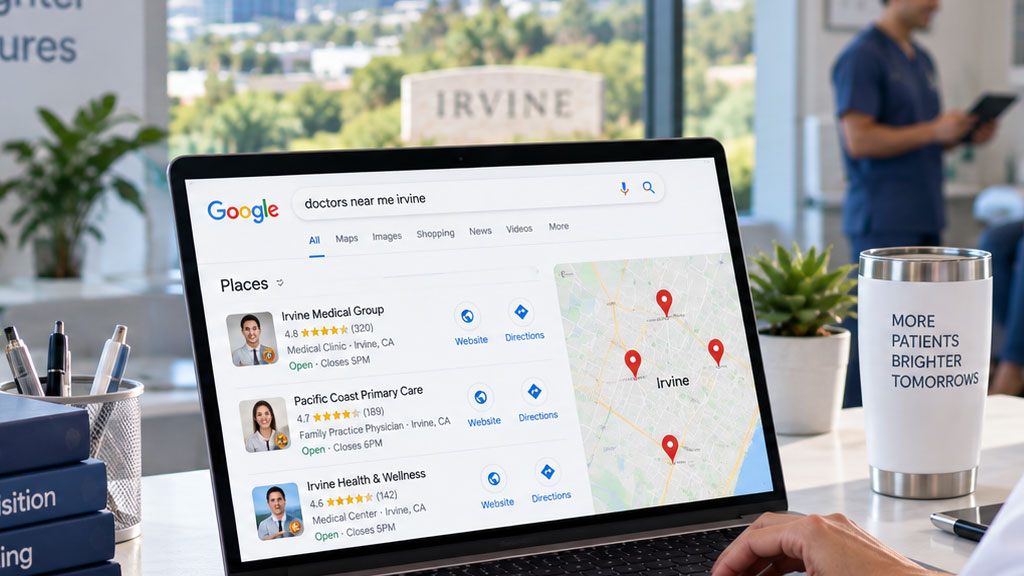
Healthcare SEO helps your pages appear when people search for a doctor, clinic, service, treatment, or health topic. Local SEO helps nearby patients find an office in Google Search and Maps.
Good SEO starts with search intent. A treatment page should answer treatment questions. A provider page should explain who gives the care. A location page should help people learn about that real office.
For local search, keep your business details correct. Improve your Google Business Profile. Build useful pages for each real office. Also, avoid making many thin city pages that only change the city name.
Paid Search for Healthcare
Paid search can put your healthcare group in front of people who are ready to act. It can help when a new office needs demand fast or when a key service has strong search demand.
However, paid traffic cannot fix a weak website. Ads work best when the search term, ad, page, and next step all match.
SEO and paid search can work together. Paid ads can create fast reach. SEO can build search reach over time.
Content, AI Search, and Patient Trust
Good healthcare content answers real questions. It can explain care, who may be a fit, what to expect, how to prepare, and what questions to ask.
Search is also changing. People may now see answers through Google AI search tools, ChatGPT, Gemini, and Perplexity. However, the goal should not be to write for bots.
Instead, write clear and useful content. Add real expert insight. Give direct answers. Support key facts. Keep important pages easy to find and read.
Blue Stage principle: Do not write for a chatbot. Write the clearest and most useful answer you can.
Turn Healthcare Website Traffic Into Appointments
Your website should make the next step easy. A patient should quickly see what you do, who gives care, where you are, and how to contact you.
Keep forms simple. Make phone numbers easy to find. Use clear calls to action. Show useful facts about staff, care, and locations. In addition, make sure the site works well on a phone.
More traffic will not help much if people cannot take the next step.
Reputation and Reviews
Reviews can shape trust before a patient calls. They can also show where the patient journey is weak.
For example, many reviews about long hold times or poor follow-up may point to a real business issue. Therefore, look at more than star ratings. Read what people say and look for patterns.
For groups with many offices, track reviews by location. This can help teams find and fix local problems faster.
How to Measure Healthcare Marketing
Do not stop at clicks and traffic. Track the full path:
Impression → Click → Inquiry → Good Lead → Booked Visit → Patient
Useful numbers may include calls, forms, booked visits, site conversion rate, cost per good lead, cost per booked visit, local search reach, and results by service or office.
Blue Stage insight: A report should help leaders decide what to do next. If a number does not help with that choice, it should not be the main focus.
Digital Marketing for Multi-Location Healthcare Groups
Groups with many offices need both central control and strong local pages. Each office should have correct details, useful local content, reviews, and clear tracking.
Do not copy one page across many cities. Each real office should show its own staff, services, address, hours, and other useful facts when those details are true.
This helps both patients and search engines know which office is the best match.
How Much Does Healthcare Digital Marketing Cost?
There is no one fair price for every healthcare group. Cost can change based on the number of offices, market size, services, ad spend, website needs, content, tracking, and staff support.
- Focused: One location and a small set of services.
- Growth: More channels in a tough market.
- Multi-location: Many offices with one central plan and local work.
The better question is not only, “What does it cost?” Ask, “What should this spend help us gain, and how will we know?”
How to Choose a Healthcare Digital Marketing Agency
Look for a team that can explain how its work can support patient growth. Ask how it will choose channels, track results, improve pages, handle local search, and report on good leads and booked visits.
Also, ask what the team would not do. A good partner should be willing to say when more ads, blogs, or SEO are not the first fix.
- How will you measure patient growth?
- What would you fix first?
- Who owns our accounts and data?
- How will you handle many locations?
- How do you review privacy and tracking needs?
- Who writes and checks the content?
When More Marketing Is Not the Answer
More traffic may not help if calls go unanswered, forms fail, staff follow-up is slow, reviews are poor, or there is no room for more patients.
In these cases, fixing the patient journey may create more value than buying more traffic.
Simple rule: More traffic cannot fix a broken patient journey.
Is Digital Marketing for Healthcare Worth It?
Yes, it can be. Digital marketing works best when the plan matches real patient demand and the healthcare group can turn that demand into care.
SEO may be best for long-term reach. Paid search may be best when fast demand matters. Conversion work may be best when traffic is strong but booking is weak.
The right mix depends on where growth is blocked.
Build a Healthcare Patient Acquisition System
The goal is not to buy every marketing service. The goal is to build a system that helps the right people find you, trust you, book care, and show you what works.
Blue Stage Marketing uses five steps: get found, build trust, convert, measure, and improve. This helps show whether the next step should be SEO, paid media, local search, content, website work, reviews, tracking, or a mix.
If your healthcare group has weak search reach, high ad costs, poor site conversion, weak local results, or unclear ROI, start by finding the main block in the patient journey.
Blue Stage Marketing
5000 Birch St Suite 3000
Newport Beach, CA 92660
949-989-4786
info@bluestagemarketing.com
Next step: Request a healthcare digital marketing strategy consultation to find the areas most likely to support patient growth.
Frequently Asked Questions About Digital Marketing for Healthcare
What is digital marketing for healthcare?
It uses online tools such as SEO, paid search, content, reviews, websites, and local search to help healthcare groups reach and convert new patients.
What is the best digital marketing strategy for healthcare?
The best plan depends on the main growth problem. Use SEO for long-term reach, paid search for fast demand, local SEO for Maps, and conversion work when traffic does not lead to bookings.
How much does healthcare digital marketing cost?
Cost depends on the number of locations, market, services, ad spend, content, website needs, tracking, and staff support. A small local plan will have a very different scope from a large multi-location plan.
Is SEO or PPC better for medical practices?
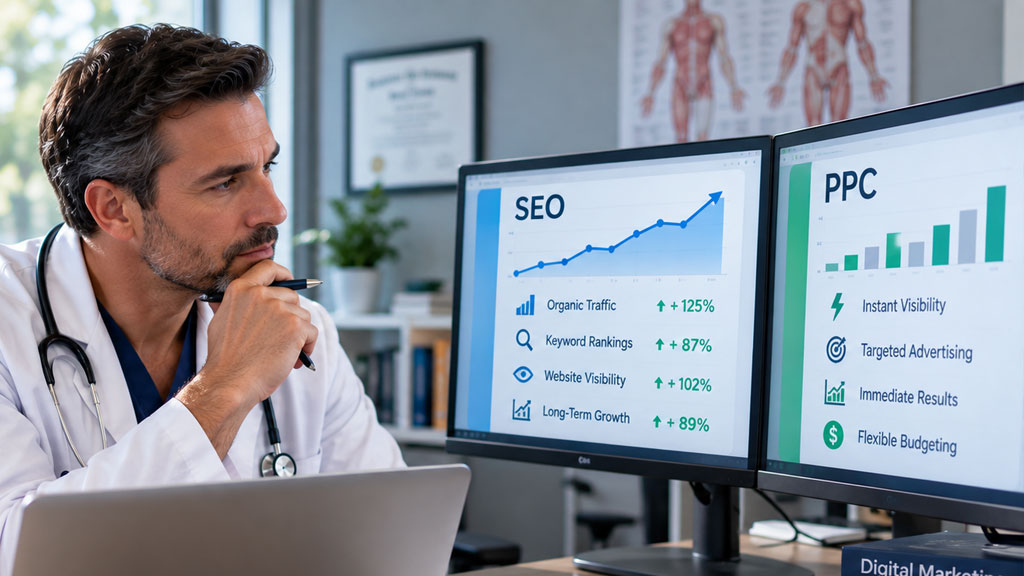
SEO is often better for long-term search growth. PPC can create fast visibility. Many practices use both because each solves a different need.
How do I choose a healthcare digital marketing agency?
Choose a team that can link its work to good leads, booked visits, and clear goals. Ask how it sets priorities, tracks results, manages accounts, handles local search, and reviews privacy needs.